- Aug 13
- By DREXEY Editorial
Lab-grown emerald vs. natural emerald is primarily a comparison of origin, not a choice between emerald and an imitation. When both materials are correctly identified, they are green beryl with essentially the same defining chemical, physical, and optical properties. Natural emerald forms through rare geological conditions, while laboratory-grown emerald crystallizes in a controlled growth environment.
That difference in origin affects the inclusions you may see, how consistently color can be matched, whether clarity enhancement is common, how rarity influences price, and what documentation matters. It does not mean that every laboratory-grown emerald is flawless or that every natural emerald is heavily included.
Quick answer
Choose a laboratory-grown emerald if you want saturated green color, a generally cleaner appearance, close matching, and a more accessible price. Choose a natural emerald if geological rarity, individual natural inclusions, documented mine origin, or collector interest matters more to you. In either case, judge the actual color, cut, treatment disclosure, setting, and documentation rather than relying on the origin label alone.
Lab-Grown Emerald vs. Natural Emerald at a Glance
| Feature | Laboratory-Grown Emerald | Natural Emerald |
|---|---|---|
| Material | Laboratory-grown green beryl with the defining properties of emerald | Geologically formed green beryl |
| Origin | Controlled laboratory growth | Formed in the earth under unusual geological conditions |
| Common growth routes | Hydrothermal or flux growth | Natural crystallization from geological fluids and reactions |
| Typical appearance | Often cleaner and more consistent, but growth features can still be present | Often shows visible inclusions, fissures, zoning, and individual internal character |
| Clarity enhancement | Not established by origin alone; ask for treatment disclosure | Fracture filling with oil or resin is common and should be disclosed |
| Hardness | About 7.5 to 8 on the Mohs scale | About 7.5 to 8 on the Mohs scale |
| Rarity and price | Not geologically rare; generally more accessible at comparable visible size and quality | Fine material is geologically rare; price can rise sharply with color, clarity, size, treatment level, and documented origin |
| Best reason to choose it | Color, visual presence, matching, and design value | Natural rarity, individuality, provenance, and collector appeal |
What Do Lab-Grown and Natural Emerald Share?
Emerald is the green variety of the mineral beryl. Its basic chemical formula is Be3Al2Si6O18, while chromium, vanadium, iron, and other trace elements influence the color. Both natural and correctly identified laboratory-grown emerald have the beryl crystal structure and the optical and physical behavior that define emerald.
This is why a hydrothermal laboratory-grown emerald is not green glass, cubic zirconia, or dyed corundum. Those would be different materials. Under the FTC Jewelry Guides, the words “laboratory-grown” or “laboratory-created” should immediately qualify the gemstone name, and the material must have essentially the same defining properties as the named natural stone.
“Same material” does not mean that every trace element, inclusion, or growth feature is identical. Those differences are exactly what allow a trained gemologist or gemological laboratory to identify whether an emerald formed naturally or in a laboratory.
How Natural Emerald Forms
Natural emerald requires an uncommon meeting of ingredients and geological conditions. Beryllium is scarce in the earth’s upper crust, while the chromium or vanadium that can create emerald green is often concentrated in very different rocks. Emerald deposits form only where these components are brought together under the right temperature, pressure, fluid, and chemical conditions.
That geological difficulty contributes to natural emerald’s rarity. It also creates variation. One crystal may show a pure, saturated green; another may lean slightly blue or yellow. Internal fluid inclusions, mineral crystals, healed fissures, growth tubes, and color zoning may record the environment in which the stone formed. The mossy or garden-like appearance associated with some of these features is often called jardin.
How Laboratory-Grown Emerald Is Made
Laboratory-grown emerald is commonly produced by hydrothermal or flux growth. Neither process is the same as making glass, and emerald is not normally produced by the low-cost flame-fusion route used for large volumes of synthetic corundum.
In hydrothermal growth, emerald-forming ingredients are dissolved in a hot, pressurized, water-based solution inside an autoclave. A controlled temperature difference transports dissolved material toward a seed crystal, where beryl grows gradually. Flux growth uses a molten solvent to help emerald crystallize more slowly.
According to current written specifications from Drexey’s supplier, the laboratory-grown emerald used in Drexey jewelry is hydrothermally grown. Hydrothermal growth is well suited to beryl and gives our cutters a controlled starting point for saturated color, calibrated shapes, and close matching. The supplier specification documents the growth route; it does not replace evaluation of the finished stone’s color, cut, polish, or setting.

Color and Clarity: What You Can Actually See
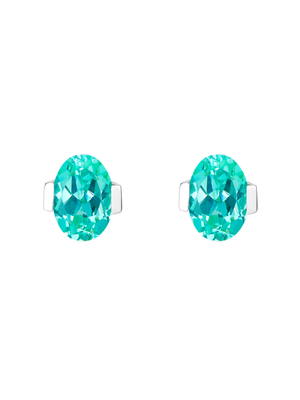
Color remains the first quality factor to judge in either origin. Look for a green that feels vivid without becoming so dark that the center appears closed. View the stone in indirect daylight and ordinary indoor light. Cut depth, facet proportions, orientation, and the metal surrounding the stone can all change how the color reads.
Laboratory growth can make saturated color and close matching more repeatable. That is especially useful for pairs, three-stone designs, and continuous-line jewelry. Natural emerald offers more variation, and many buyers value the individuality of a stone whose inclusions and color zoning are unique.
Natural emerald commonly contains eye-visible inclusions and fissures. Laboratory-grown emerald can look cleaner, but it is not automatically inclusion-free. Hydrothermal material may show chevron graining, seed-related features, nailhead spicules, tubes, cavities, or growth zoning. Some of these features require magnification to see.
Clarity is not an origin test. A clean-looking emerald is not automatically laboratory-grown, and a visibly included emerald is not automatically natural.
“Colombian Green” Is a Color Direction, Not a Mine Origin
Natural emeralds from Colombia are known for highly valued green colors, but appearance alone cannot prove geographic origin. Emerald colors from different deposits overlap, and a gemological laboratory uses inclusions, chemistry, spectroscopy, and other evidence when issuing an origin opinion.
For laboratory-grown material, a phrase such as Colombian green describes a color direction only. It does not mean the stone was mined in Colombia. Drexey identifies the material first as laboratory-grown emerald, then uses color language to help shoppers understand the shade.
Treatments: Growth Method and Clarity Enhancement Are Different Questions
Many natural emeralds have surface-reaching fissures filled with oil, resin, or another substance to reduce their visibility. This is a widely accepted practice when it is disclosed, but the amount and type of enhancement can affect value, appearance, and care.
Laboratory-grown emerald often begins with fewer distracting fissures than typical commercial natural material, but laboratory origin does not prove that a stone is untreated. Ask two separate questions:
- How was the crystal grown? For example, hydrothermal or flux growth.
- Was the finished stone treated after growth? For example, fracture filling or surface coating.
A seller should answer both clearly. A growth-method name is not a treatment disclosure.
Durability and Care
Both origins share emerald’s Mohs hardness of about 7.5 to 8. Hardness measures resistance to scratching, not resistance to chipping or breaking. Toughness varies with internal fissures, surface-reaching fractures, cut, setting, and treatment.
A laboratory-grown emerald with fewer surface-reaching fissures may have a practical durability advantage over a heavily fractured natural emerald, but origin alone does not guarantee it. An exposed corner, a poor setting, or a hard impact can damage either stone. Protective bezels, secure prongs, and thoughtful wear matter.
For Drexey emerald jewelry, use lukewarm water, a small amount of mild soap, and a very soft brush. Rinse carefully and dry completely. Avoid ultrasonic and steam cleaners, sudden temperature changes, harsh chemicals, and hard knocks. This conservative routine also protects the setting and metal finish.

Price, Rarity, and Resale Value
Fine natural emerald is expensive because gem-quality material is geologically rare. Price can change dramatically with hue, tone, saturation, transparency, size, cut, treatment level, and verified geographic origin. Two natural emeralds of the same carat weight may have very different values.
Laboratory-grown emerald is generally more accessible because production is controlled and the price does not include geological rarity. That can make a larger visible stone, stronger saturation, or a closely matched design possible at a lower price than a comparable-looking natural emerald.
Natural emerald has the more established collector and resale market, particularly for exceptional documented stones. That does not make ordinary natural emerald jewelry a guaranteed investment. Laboratory-grown emerald usually has limited resale value because new material can continue to be produced. Buy either origin for the color, design, craftsmanship, and wearing experience rather than a promised financial return.
Can You Tell Natural and Lab-Grown Emerald Apart by Eye?
Not reliably. Visible inclusions can offer clues, but a shopper should not identify origin from color, clarity, or a photograph. Skilled gemologists combine magnification with spectroscopy, trace-element analysis, and other tests. GIA’s colored stone reports can state whether an emerald is natural or laboratory-grown and identify detectable treatments. For eligible natural emeralds, an origin report may also provide a geographic-origin opinion.
A brand authenticity card may document what the seller represents, but it is not the same as an independent gemological report. For a high-value natural emerald or any purchase priced around a geographic-origin claim, an independent report is especially useful.
Is Laboratory-Grown Emerald Automatically More Sustainable?
Laboratory-grown emerald avoids gemstone mining, but it still requires equipment, energy, raw materials, cutting, metal, manufacturing, and shipping. Natural emerald supply chains also vary widely. Origin alone is not a complete environmental or ethical score.
Look for evidence about energy, traceability, labor, metal sourcing, production, and transport before accepting a broad sustainability claim. Drexey does not treat “laboratory-grown” as a substitute for supporting information.
Which Emerald Should You Choose?
Choose laboratory-grown emerald if you prioritize:
- Saturated green color at a more accessible price
- A generally cleaner visual appearance
- Calibrated sizes and close color matching
- Design presence rather than geological rarity
- Clear laboratory-origin and growth-method disclosure
Choose natural emerald if you prioritize:
- Geological rarity and natural formation history
- Unique inclusions and individual internal character
- Verified mine origin or collector interest
- The established market for exceptional documented natural stones
- Owning a gemstone whose value story is centered on rarity
Neither origin replaces quality. A well-chosen emerald should have a color you love, a cut that presents that color well, disclosed treatments, and a setting suited to how you plan to wear it. For a broader discussion of cost and value across colored gem materials, read Are Lab-Grown Gemstones Worth It?
What to Check Before Buying an Emerald
- Read the full material name. Look for “laboratory-grown emerald” or “natural emerald,” not an unqualified color name.
- Separate color from origin. “Colombian green” can describe a shade. It does not prove Colombian mine origin.
- Ask about the growth method. Hydrothermal and flux describe how laboratory-grown emerald crystallized.
- Ask about treatments separately. Confirm whether the finished stone has oil, resin, coating, or another enhancement.
- Judge color in more than one light. Look for saturation, tone, dark areas, and color distribution.
- Check dimensions as well as carat weight. Face-up size and cut proportions often tell you more about visual presence.
- Inspect the setting. Secure prongs or a protective bezel matter, especially for a ring worn frequently.
- Use an independent report when the claim warrants it. This is particularly important for expensive natural material, treatment level, or geographic origin.
If you want a clear foundation before comparing other laboratory-grown stones, read What Are Lab-Grown Gemstones?
Frequently Asked Questions
Is laboratory-grown emerald the same material as natural emerald?
It has essentially the same defining chemical, physical, and optical properties as natural emerald and the same beryl crystal structure. The origin, trace chemistry, inclusion patterns, and growth features can differ.
Is hydrothermal laboratory-grown emerald a simulant?
No. A correctly identified hydrothermal laboratory-grown emerald is emerald material grown in a laboratory. A simulant is a different material, such as green glass, chosen to resemble emerald.
Do laboratory-grown emeralds have inclusions?
They can. Hydrothermal emerald may show growth zoning, chevron graining, tubes, cavities, seed-related features, or nailhead spicules. Laboratory-grown does not mean flawless.
Is laboratory-grown emerald more durable than natural emerald?
Not automatically. Both share emerald’s hardness, but toughness depends on fractures, inclusions, treatment, cut, and setting. Cleaner laboratory-grown material may contain fewer vulnerable fissures than a heavily included natural stone, but every finished piece should be judged individually.
Does a Colombian-green laboratory-grown emerald come from Colombia?
No. “Colombian green” describes a color direction when used for laboratory-grown material. Geographic mine origin applies to natural emerald and should be supported by appropriate evidence.
Do laboratory-grown emeralds hold their value?
They generally have limited resale value because additional material can be produced. Exceptional natural emeralds have the more established collector market, but no emerald jewelry purchase should be presented as a guaranteed investment.
What is the safest way to clean emerald jewelry?
Use lukewarm water, mild soap, and a very soft brush, then rinse and dry thoroughly. Avoid ultrasonic and steam cleaners, harsh chemicals, rapid temperature changes, and impact.
The Drexey View
Natural emerald offers geological rarity and an internal world shaped by the earth. Hydrothermal laboratory-grown emerald offers controlled color, a generally cleaner appearance, and stronger design access. Drexey chooses documented hydrothermal laboratory-grown emerald because it supports the saturated color, calibrated cutting, and close matching central to our color-led jewelry.
The choice is not about declaring one origin universally better. It is about knowing exactly what the stone is, understanding what creates its value, and choosing the color and design you will genuinely want to wear.
Last reviewed: August 2026. Drexey’s growth-method statement reflects current written supplier specifications. Product-specific material and treatment records should take priority if specifications change.
Editorial Research Sources
- GIA: Emerald Gem Encyclopedia
- GIA: Emerald Quality Factors
- GIA: Geology of Corundum and Emerald Gem Deposits
- GIA: Laboratory Growth of Gem Materials and the Attempt to Replicate Nature
- GIA: Does GIA Grade Emerald?
- GIA: Emerald Care and Cleaning Guide
- FTC Jewelry Guides: 16 CFR § 23.25
- FTC Consumer Advice: Buying Gemstones, Diamonds, and Pearls