- Aug 28
- By DREXEY Editorial
Let’s start with the question people are usually too polite to ask:
If the gemstone was grown in a lab, why isn’t the jewelry cheap?
Fair question.
The short answer is that laboratory growth can remove much of the geological rarity premium attached to a comparable natural stone. It does not remove the cost of growing a usable crystal, cutting it well, matching its color, building the setting, setting every stone, finishing the metal, inspecting the piece, or standing behind it after purchase.
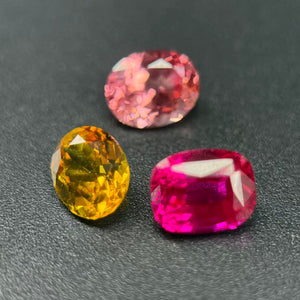
A crystal coming out of a laboratory is not a finished jewel. It is closer to an ingredient.
The quick answer: what do lab-grown gemstones cost?
There is no honest universal price per carat for “lab-grown gemstones.” Sapphire, emerald, diamond, moissanite, and YAG are different materials. They can be made by different processes, cut to different standards, and sold either loose or inside jewelry made from sterling silver, gold vermeil, or solid gold.
That is why two pieces with stones of a similar face-up size can have very different prices—and why a single percentage such as “the gemstone is 20% of the retail price” is usually meaningless without knowing the design.
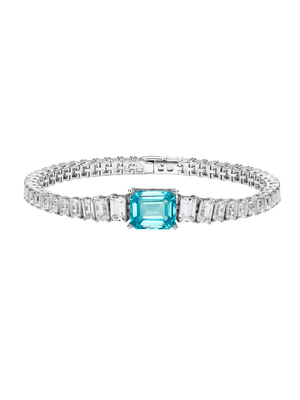
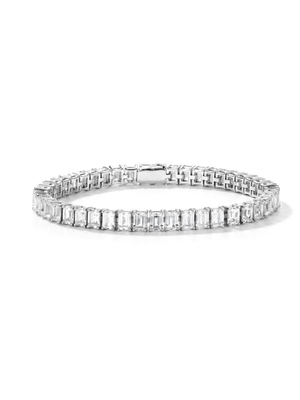
For a simple solitaire pendant, the center stone may be one of the most visible cost drivers. In a tennis bracelet, dozens of calibrated stones, repeated hand-setting, flexible links, metal weight, and clasp construction may matter more than the price of any one stone.
The better question is not just, “What did the rough crystal cost?” It is:
What had to happen between growing the crystal and making a piece you would actually want to wear?
The seven layers behind a lab-grown gemstone jewelry price
| Cost layer | What you are paying for | What to look for |
|---|---|---|
| Crystal growth | Equipment, high-purity ingredients, energy, time, seed material, color-producing trace elements, and failed or unusable output | Exact material and, when relevant, documented growth method |
| Rough selection | Sorting for color, clarity, orientation, cracks, zoning, and usable size | Consistent color and no distracting face-up defects |
| Cutting and polishing | Planning, preforming, faceting, polishing, weight loss, recutting, and rejected stones | Brightness, symmetry, crisp facet junctions, and minimal windowing |
| Matching and calibration | Finding stones that agree in dimensions, tone, saturation, and cut | Even pairs, balanced side stones, and consistent tennis layouts |
| Metal and construction | Sterling silver, vermeil, solid gold, metal weight, casting loss, findings, prongs, links, and clasps | Full metal disclosure, secure settings, and a structure suited to wear |
| Jewelry labor | CAD and sample development, casting, assembly, stone setting, polishing, plating, and final finishing | Clean prongs, smooth surfaces, balanced alignment, and comfortable wear |
| Service around the piece | Quality control, packaging, shipping, customer care, returns, repairs, and warranty | Clear policies and a seller that remains accountable after checkout |
No two designs distribute these costs in exactly the same way. That is the first thing any transparent price explanation should admit.
1. The growth method changes the starting cost
“Lab-grown” describes origin. It does not describe one recipe.
Czochralski-grown sapphire and ruby
In the Czochralski—or crystal-pulling—process, a seed is introduced to a molten material, then slowly rotated and pulled while the crystal forms. GIA notes that Czochralski-grown corundum can have highly uniform trace-element distribution, and the method can produce large crystals with controlled consistency.
Drexey’s current laboratory-grown sapphire and ruby program is specified by our suppliers as Czochralski-grown. For us, the practical value is not the technical name by itself. It is the starting consistency it can offer when we need vivid color, larger cuts, calibrated dimensions, or multiple stones that must look related.
That does not mean every pulled crystal becomes a beautiful gem, or that the growth method can rescue poor cutting. It means the rough begins with a different production process and cost structure than faster, high-volume alternatives.
Hydrothermal lab-grown emerald
Hydrothermal growth uses heat and pressure inside an autoclave to grow crystal from a solution. GIA describes hydrothermal growth as a slow and expensive process compared with simpler mass-production methods.
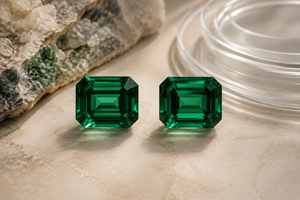
Drexey’s laboratory-grown emerald is supplier-specified as hydrothermally grown. It is emerald material—beryl with the defining properties of emerald—not green glass and not green corundum. The finished price still depends on the color, usable portion of the crystal, internal features, cut, polish, and jewelry setting.
This is one reason it makes little sense to ask why a hydrothermal emerald and an inexpensive flame-fusion stone do not cost the same simply because both were made in a laboratory.
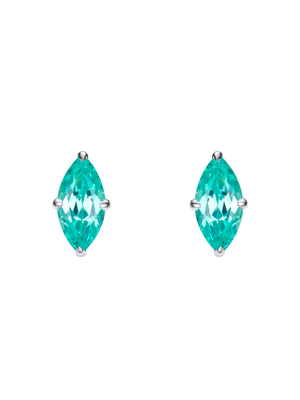
Paraiba Hue YAG
YAG is yttrium aluminum garnet, a laboratory-created crystal with a garnet-type structure. It is not tourmaline and it is not laboratory-grown Paraiba tourmaline. “Paraiba Hue” describes the electric blue-green color direction; “YAG” identifies the material.
Drexey’s Paraiba Hue YAG is supplier-specified as Czochralski-grown. Its price reflects its own production, color, clarity, cutting, and use in a finished design—not the geological rarity or provenance of natural copper-bearing Paraiba tourmaline.
If you want the full material explanation, read What Is Paraiba Hue YAG?.
What about flame fusion?
Flame fusion is a faster and generally lower-cost way to produce some synthetic corundum and spinel. That makes it useful for accessible, high-volume jewelry.
But production method alone is not a finished quality grade. A flame-fusion stone can be cut carefully, and a more expensive crystal can still be cut badly. The growth method tells you how the rough began; the face-up stone tells you what the cutter and jeweler did with it.
2. Growing a crystal is not the same as growing a usable gemstone
The laboratory may produce a large boule, plate, or crystal, but a cutter cannot necessarily use every part of it for the desired design.
Sections may be rejected because of:
- uneven color or unwanted zoning;
- internal strain, fractures, bubbles, cavities, or other visible features;
- an orientation that produces weak face-up color;
- insufficient depth for the intended cut;
- dimensions that cannot yield the required calibrated stone;
- damage during sawing, preforming, faceting, or polishing.
This is the part that disappears when someone says, “The rough only costs X per gram.” Jewelry is not priced by weighing an entire rough crystal and pretending all of it ends up on your hand.
Cutting always involves a tradeoff between retaining weight and creating a better-looking stone. GIA’s colored-stone research explains that a shallow gem may show a transparent “window,” while an overly deep gem can look dark or face up smaller than its weight suggests. A cutter may sacrifice more rough to get better brightness, color, and proportions.
That lost weight is part of the cost of the finished stone.
3. Color can cost more—even when rarity is controlled
Natural gemstone prices often include a scarcity premium tied to geology, mine origin, treatment history, and limited supply. Lab growth changes that equation, but it does not make every color equally easy to produce or equally desirable after cutting.
For colored stones, color is usually the first thing the eye judges. GIA treats hue, tone, saturation, and color uniformity as central value factors. In practical terms, that means a stone can be technically clean but still look gray, overly dark, washed out, uneven, or lifeless.
A jewelry maker may sort through multiple stones to find one vivid center, two closely matched earrings, or a continuous row that does not visibly jump from one tone to another.
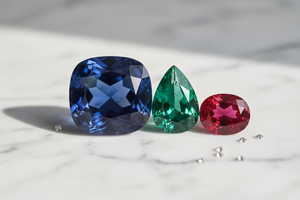
So when two lab-grown sapphires have the same dimensions, the one with more attractive face-up color, better light return, and cleaner finishing can reasonably cost more. Laboratory origin creates more control; it does not make visual quality irrelevant.
4. Precision cutting is labor, not a button
The retail price of a finished gemstone is not simply the raw crystal price plus a tiny polishing fee.
A faceted stone must be planned for its material. Sapphire, emerald, and YAG do not bend light in exactly the same way, so copying one set of angles across every material will not necessarily produce the best result. The cutter has to balance color, brightness, contrast, depth, spread, symmetry, and retained weight.
Look closely at a stone and ask:
- Does the center look transparent and empty because of windowing?
- Do large areas stay black instead of returning color?
- Are the outline and corners symmetrical?
- Do the facet junctions meet cleanly?
- Does the polish look crisp under magnification?
- Does the stone show its color across most of its face?
A larger carat number does not correct a weak cut. Sometimes the smaller, better-proportioned stone is the more expensive one to produce—and the better one to wear.
5. Matching multiplies the work
One good stone is a selection. A good pair is a match. A bracelet can be an entire sorting project.
Matching is not only about carat weight. Stones may need to agree in millimeter dimensions, outline, depth, hue, tone, saturation, clarity, and facet pattern. Even a small mismatch can become obvious when two stones sit beside each other.
This changes the price anatomy by design:
- A solitaire such as the ALIX emerald-cut necklace concentrates attention on one center stone and its setting.
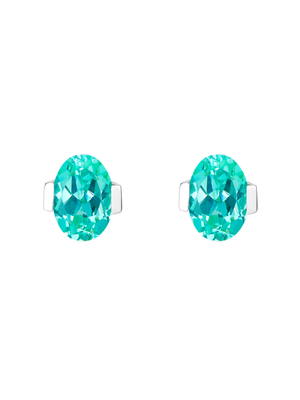
- A pair such as the ROMY oval stud earrings requires two stones that read as a pair, not simply two stones of the same nominal weight.
- A three-stone design such as the ARIANE emerald-cut ring adds proportion, alignment, and side-stone balance.
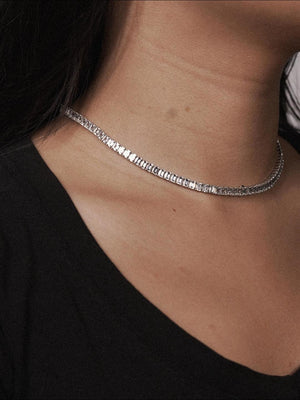
- A continuous-line piece such as the CŒUR LAC tennis bracelet adds repeated calibration, articulation, setting labor, and clasp engineering across the whole piece.
More stones do not just add material. They add more opportunities for mismatch, alignment errors, loose settings, and rejection.
6. The gemstone may not be the most expensive material in the piece
When comparing jewelry prices, check the metal before assuming the difference comes from the stone.
Sterling silver, gold vermeil, and 14K solid gold are not interchangeable labels. Their raw-material costs, casting behavior, finishing steps, weight, wear characteristics, and repair options differ.
The same gemstone design can cost substantially more in solid gold because the setting, band, chain, links, prongs, and clasp contain more precious-metal value. A wide sculptural ring also uses more metal than a fine wire band. A tennis bracelet needs many moving links and a secure closure. A necklace adds chain length and findings.
For vermeil, the base should be sterling silver and the gold layer should be disclosed accurately. For solid gold, look for karat and color. “Gold tone” tells you almost nothing about composition.
The fairest comparison is always like for like:
- same gemstone material;
- similar dimensions and cut quality;
- similar stone count;
- comparable metal and metal weight;
- comparable setting and construction;
- comparable policies and warranty.
7. Made-to-order and mass production have different economics
Mass production can spread development, molds, labor setup, and inventory costs across a large run. Made-to-order jewelry may avoid holding large quantities of finished inventory, but it requires individual order handling, material allocation, production scheduling, finishing, and quality control for each piece.
Neither model is automatically better. They simply create different cost structures.
At Drexey, many designs are handcrafted to order and production begins shortly after purchase. That model supports multiple gemstone colors and metal choices without producing every possible combination in advance. It also means a customer is paying for an individually scheduled piece, not pulling a finished unit from a mass-production bin.
What laboratory growth makes more accessible—and what it does not
Laboratory growth can make vivid color, larger face-up sizes, and coordinated stones more accessible than comparable top-quality natural gems. It can also reduce dependence on geological rarity and mine provenance.
It does not make these things free:
- controlled crystal production;
- sorting and rejection;
- skilled cutting and polishing;
- matching multiple stones;
- precious metal;
- secure setting and finishing;
- product development;
- inspection, shipping, service, returns, repair, and warranty.
It also does not automatically prove that a product is sustainable. Energy sources, production efficiency, material sourcing, factory practices, metal choice, packaging, logistics, and product lifespan all affect environmental impact. A broad environmental claim should be supported by supply-chain-specific evidence, not assumed from the word “lab-grown.”
So, are expensive lab-grown gemstones a rip-off?
Not automatically. Cheap is not automatically dishonest, either.
A lower price may reflect a faster growth method, commercial cutting, simpler construction, lower-cost metal, lighter metal weight, large production volume, or limited service. A higher price may reflect slower crystal growth, more selective color, precision cutting, extensive matching, heavier or solid-gold construction, complex setting, original design, smaller production runs, and stronger after-sales support.
The price becomes questionable when the seller cannot explain what the material is, how the jewelry is made, or what the customer receives for the difference.
You should not have to pay a premium for a mystery.
Red flags when comparing lab-grown gemstone prices
Be cautious when you see:
- A color name used as the material name. “Paraiba,” “emerald green,” or “ruby red” does not tell you whether the object is tourmaline, beryl, corundum, YAG, glass, or a coated composite.
- “Lab-grown” with no gemstone identity. Laboratory-grown what?
- Huge permanent discounts from an unverifiable comparison price. A dramatic crossed-out price is not proof of material value.
- Carat weight without millimeter dimensions. Different materials have different densities, and a deep stone may weigh more while looking smaller from the top.
- No close images or movement video. You need enough visual information to assess color, windowing, dark areas, and setting quality.
- Vague metal language. “Premium gold finish” is not the same as 14K solid gold or clearly specified vermeil.
- A premium growth-method claim with no documentation. A seller should know whether that statement comes from testing, a supplier specification, or assumption.
- “Eco-friendly” treated as automatic. Ask what specific evidence supports the claim.
For a material-first explanation of sapphire, ruby, emerald, moissanite, and YAG, read What Are Lab-Grown Gemstones?.
A simple way to decide whether the price is fair
Before buying, answer these eight questions:
- What is the exact gemstone material?
- Is its laboratory origin disclosed clearly?
- Is the growth method stated accurately, if the seller uses it as a selling point?
- What are the stone’s millimeter dimensions, not only its carat weight?
- Does the cut look bright, balanced, and intentional in actual images?
- Are multiple stones well matched?
- What is the metal, and how is the piece constructed?
- What return, repair, and warranty support comes with it?
If the answers are specific and visible, you can compare value. If the answers are mostly adjectives, you are comparing marketing.
Frequently asked questions
Why are some lab-grown gemstones so cheap?
Some materials can be produced quickly and at high volume, then cut in standard commercial shapes. Simple settings, low-cost metal, light construction, and mass production can reduce the finished price further. A low price is not automatically a problem if the material and construction are disclosed honestly.
Why are some lab-grown gemstones expensive?
The price may reflect the growth process, usable yield, color selection, size, precision cutting, matching, metal, design complexity, stone-setting labor, production scale, and after-sales support. “Lab-grown” removes mine origin; it does not remove the rest of jewelry making.
Is a lab-grown gemstone priced by carat?
Loose stones may be quoted by carat, but carat is weight—not face-up size or beauty. Material density, dimensions, color, clarity, cut, and finish all matter. Finished jewelry also includes metal, construction, setting labor, and service.
Is Czochralski-grown sapphire worth more than flame-fusion sapphire?
The Czochralski process generally has a different equipment, control, and production profile, and it can produce large, highly uniform crystals. But growth method alone does not guarantee a more beautiful finished stone. Compare material identity, color, cut, dimensions, and visible quality before paying more.
Is hydrothermal lab-grown emerald the same as green glass?
No. Properly identified hydrothermal laboratory-grown emerald is synthetic emerald material—beryl with the defining properties of emerald. Green glass is a different substance and should not be sold as laboratory-grown emerald.
Do lab-grown gemstones hold their value?
They should generally be purchased for color, design, and wear rather than as an investment. Resale markets for colored lab-grown stones are limited and inconsistent, and the resale value of a finished piece also depends on metal, brand demand, condition, and craftsmanship.
Are lab-grown gemstones always more sustainable?
No universal claim can be made from origin alone. Laboratory production uses equipment, energy, and raw materials; jewelry also includes metal, manufacturing, packaging, and transport. Meaningful environmental comparisons require specific, verifiable supply-chain data.
The bottom line
Lab-grown gemstones make one part of fine jewelry more accessible: the color and visual presence of a gemstone do not have to depend entirely on geological rarity.
But a finished piece is still the result of choices—what crystal to grow, which section to cut, how much rough to sacrifice, which facets to polish, which stones to match, how much metal to use, how securely to set them, and how carefully to finish the piece.
The most useful price question is not, “Was it made in a lab?”
It is:
Can I see what I am paying for?
Pay for material identity you can verify, color you genuinely love, cutting you can see, construction designed to last, and service that exists after the sale. That is a much better measure of value than either a high price or a suspiciously low one.
Editorial disclosure
Drexey sells jewelry made with laboratory-grown gemstones and laboratory-created YAG and therefore has a commercial interest in this topic. Growth-method statements about Drexey materials are based on current written supplier specifications. Independent gemological and U.S. naming guidance is linked below.
Sources and further reading
- GIA: An Introduction to Synthetic Gem Materials
- GIA: Laboratory Growth of Gem Materials and the Attempt to Replicate Nature
- GIA: Colored Gemstone Value Factors
- GIA: Colored Stone Cut Quality—What to Look For
- GIA: Luminescent Synthetic Garnet-Like Crystals
- FTC: In the Loupe—Advertising Diamonds, Gemstones and Pearls