- Aug 03
- By DREXEY Editorial
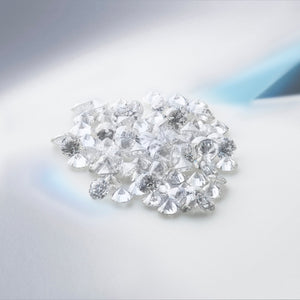
Lab-grown white sapphire and lab-created moissanite can both give jewelry a clean, colorless look, but they do not create the same effect. White sapphire is known for clear depth and restrained flashes. Moissanite is brighter and more visibly fiery, often separating white light into rainbow colors.
This guide compares lab-grown white sapphire with lab-created moissanite. It does not compare natural white sapphire, whose color, clarity, treatments, rarity, and price can vary more widely. Neither material is a type of diamond, and neither should be sold as one.
For the broader distinction between a laboratory-grown mineral counterpart and a different material chosen for its appearance, read What Are Lab-Grown Gemstones?
The Quick Answer
Choose lab-grown white sapphire if you prefer quieter light, transparent depth, step cuts, and a polished look that does not try to imitate diamond. Choose lab-created moissanite if your priority is maximum sparkle, strong brilliance, and noticeable rainbow fire.
Both can work for everyday jewelry and engagement rings. Moissanite has the higher Mohs hardness, while sapphire combines high hardness with excellent toughness and no cleavage. The better choice is therefore not a simple durability contest; it depends on the visual effect, cut, setting, and maintenance you want.
Lab-Grown White Sapphire vs. Moissanite at a Glance
| Feature | Lab-Grown White Sapphire | Lab-Created Moissanite |
|---|---|---|
| Material | Corundum (aluminum oxide) | Silicon carbide |
| Origin in this comparison | Grown in a laboratory | Created in a laboratory |
| Light style | Clear, subtle, restrained flashes | Bright, lively, strongly fiery |
| Rainbow fire | Lower | Much more noticeable |
| Mohs hardness | 9 | Approximately 9.25 |
| Visible residue | Film can become noticeable sooner | Also needs cleaning; stronger fire may remain more visible |
| Best visual match | Step cuts and understated, architectural designs | Brilliant cuts and high-sparkle designs |
| Main tradeoff | Less brilliance and fire | Rainbow fire and facet doubling can feel visually busy |
| Price | No universal winner; compare equivalent size, cut, stone count, metal, and construction | |
They Are Different Gemstone Materials
White sapphire is colorless corundum, the mineral family that also includes blue, pink, yellow, and purple sapphire. GIA explains that a synthetic gem is grown in a laboratory and shares virtually all of the chemical, optical, and physical characteristics of its natural mineral counterpart. Lab-grown white sapphire is therefore sapphire material with a disclosed laboratory origin, not glass or a look-alike coating. See GIA’s introduction to synthetic gem materials.
Moissanite is silicon carbide. Natural moissanite exists, but the near-colorless material used in contemporary jewelry is laboratory-created. It is a distinct gemstone material—not sapphire and not a lab-grown diamond. Clear naming matters: the FTC’s jewelry advertising guidance calls for laboratory origin to be disclosed clearly.
Which Sparkles More?
Moissanite generally sparkles more and shows more rainbow fire. GIA’s gemological research records moissanite’s high refractive indices and dispersion, optical properties that support its strong brilliance and spectral flashes. White sapphire has lower refractive index and dispersion, so its light is usually calmer and less colorful. The result is not “good sparkle” versus “bad sparkle”; it is lively fire versus quieter transparency.

Cut can change what you see just as strongly as material. A round brilliant is designed around small, active flashes. An emerald cut uses long step facets that create broader mirrors and clearer bands of light. Compare the same shape, dimensions, cut quality, lighting, and cleanliness before deciding. A round moissanite beside an emerald-cut white sapphire is also a comparison of two cutting styles.
Hardness vs. Toughness: Which Is More Durable?
Moissanite ranks approximately 9.25 on the Mohs scale, while sapphire ranks 9. That makes both highly resistant to scratching, with moissanite holding a modest advantage in this one property. Mohs numbers are not evenly spaced, however, and hardness does not measure every kind of durability.
Hardness means resistance to scratching. Toughness concerns resistance to chipping and breaking. GIA describes corundum as having excellent toughness and no cleavage, making sapphire suitable for rings and other daily-wear settings. A secure setting, protected corners, sound proportions, and sensible wear still matter for either material. Read GIA’s sapphire durability and care guidance and its gemological study of synthetic moissanite.
Does White Sapphire Get Cloudy?
A white sapphire that looks dull often has a film of skin oil, lotion, soap, or cosmetics on its surface or pavilion. Because white sapphire produces less brilliance than moissanite, residue can interrupt its quieter light more noticeably. Cleaning can restore clarity when buildup is the cause.
Do not assume every dull-looking stone only needs soap. Poor cutting, abrasion, internal features, damage, or undisclosed treatment can also affect appearance. Moissanite needs cleaning too; stronger fire does not make it dirt-proof. If gentle cleaning does not improve the stone, ask a jeweler to inspect both the gem and its setting.
Compare Millimeters, Not Just Carats
Carat is a unit of weight, not a face-up size. GIA lists sapphire’s specific gravity at 4.00 and synthetic moissanite’s at about 3.22. Because the materials have different densities, equal-carat stones will not necessarily have equal dimensions or look equally large.
For a useful comparison, match the length and width in millimeters, shape, depth, and cut style. Then compare the finished pieces from the same viewing distance. This is especially important for elongated cushions, ovals, emerald cuts, and tennis jewelry, where spread and proportion shape the visual result.
Which Is Cheaper Like for Like?
There is no dependable rule that every lab-grown white sapphire must cost less than every moissanite, or the reverse. GIA notes that synthetic corundum is made by several growth processes and appears at many price levels. Moissanite prices also vary by manufacturer, color, clarity, cut, and size.
Finished-jewelry price adds more variables: stone count, calibrated cutting, metal weight, setting method, labor, quality control, warranty, and service. Compare two actual pieces with equivalent millimeter dimensions, cut quality, metal, and construction. If those specifications are not alike, the price difference cannot be attributed to the center-stone material alone.
Which Is Better for an Engagement Ring?
Both can be practical engagement-ring stones. Choose moissanite if you want a center stone that stays visually active across many lighting conditions. Choose lab-grown white sapphire if you prefer a calmer, glass-clear appearance and are comfortable cleaning it regularly.
There are honest tradeoffs. GIA notes that moissanite is doubly refractive, so facet junctions can appear doubled or slightly fuzzy from some directions; its intense fire is also more obvious in larger stones. White sapphire will not deliver the same brilliance and can look flat when poorly cut or coated with residue. For either option, select a protective setting for exposed corners and remove the ring for impact-heavy work.
Which Is Better for a Tennis Bracelet or Necklace?
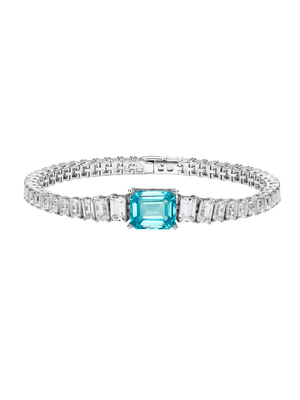
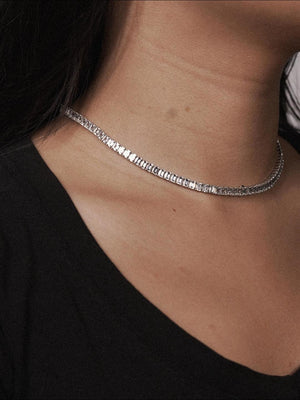
In tennis jewelry, repetition amplifies the gemstone’s visual character. Moissanite creates a high-energy line of fast, colorful sparkle. Emerald-cut white sapphire creates broader, quieter reflections with an architectural rhythm.

If you want a bracelet or necklace to flash from across a room, moissanite is likely the closer match. If you want a continuous, polished line of light that feels more restrained, white sapphire may suit the design better. Check stone dimensions, articulation, clasp security, metal, and setting consistency—not only the gemstone name.
How to Choose
- Choose lab-grown white sapphire for softer light, transparent depth, geometric step cuts, and a distinctly sapphire identity.
- Choose lab-created moissanite for greater brilliance, stronger rainbow fire, and a visually active center stone.
- Compare actual specifications when budget matters: millimeters, cut, stone count, metal, setting, and warranty.
- View video in more than one light if possible. Diffused daylight, indoor ambient light, and spot lighting can make the same gemstone behave differently.
Care and Cleaning
Warm water, mild soap, and a soft lint-free cloth are the safest starting point for both gemstones. A very soft brush can help clean beneath a stone when the setting and metal allow it. Rinse carefully and dry completely.
Always care for the complete piece, not only the gemstone. Do not soak or scrub gold-vermeil surfaces. Avoid abrasive cleaners, bleach, and harsh chemicals. Although GIA notes that ultrasonic and steam cleaning can be safe for some untreated sapphire and moissanite, a machine can loosen stones or harm certain treatments and finishes. Use one only after a jeweler confirms that the entire piece is suitable.
Frequently Asked Questions
Is lab-grown white sapphire actually sapphire?
It is laboratory-grown corundum with the defining properties of sapphire, and its origin must be disclosed. It is not mined sapphire, but it is also not glass or a material merely made to look like sapphire.
Is moissanite a lab-grown diamond?
No. Moissanite is silicon carbide; diamond is carbon. Lab-created moissanite may be used as a diamond alternative, but it is a separate material and should be identified by its own name.
Which looks more like a diamond?
Moissanite is usually brighter, but its stronger rainbow fire and doubled facet reflections can distinguish it from diamond. White sapphire has less fire and brilliance. Neither is a diamond, so choose the appearance you prefer rather than asking one material to impersonate another.
Which is better for daily wear?
Both can be suitable. Moissanite offers slightly higher scratch resistance; sapphire offers high hardness, excellent toughness, and no cleavage. Setting design, maintenance, and exposure to impacts are as important as the Mohs number.
Which stays sparkly longer between cleanings?
Moissanite’s stronger brilliance may remain more visually apparent as light residue accumulates, but both stones need cleaning. White sapphire’s restrained light tends to make film more noticeable sooner. Wear habits, setting openness, lotions, and cosmetics affect the interval.
Is white sapphire better than moissanite?
White sapphire is the better fit for understated, clear light; moissanite is the better fit for intense sparkle and fire. There is no universal winner because they solve different design goals.
The Drexey Perspective
White sapphire is not simply a quieter substitute for another colorless stone. Its restraint is its character. Drexey uses lab-grown white sapphire in the LAGO tennis designs because emerald-cut stones create a clean, modern sequence of step-cut reflections. We use moissanite where greater brilliance and fire better serve the design.
Explore the LAGO Lab-Grown White Sapphire Tennis Bracelet and LAGO Lab-Grown White Sapphire Tennis Necklace.